
Retrobulbar Haemorrhage: What a DCT should know
Author: Matthew Harrison
TLDR:
· Retrobulbar haemorrhage is a sight threatening emergency
· It is most commonly cause by blunt trauma to the mid face, but can also occur post operatively
· Clinical diagnosis is made based on a constellation of symptoms: Pain, Proptosis, Paralysis, Pupil dilation, Loss of visual acuity
· Surgical intervention in the form of Lateral Canthotomy and Cantholysis is required urgently to preserve vision
· Involve senior colleagues ASAP
· Always assess visual acuity in facial trauma, especially involving fractures of the orbit, zygoma, or maxilla
Everything in life can be compartmentalised – and OMFS on-call is no different. If one really wants to break things down to the very basics, there are only really three different true OMFS emergencies requiring a timely intervention that you may have to handle while on-call: Airway compromise, Infection, and Bleeding (or a combination of the three). This isn’t to say you have to handle these issues alone – senior support would be expected in any of these cases – however, knowledge of the pathophysiology, consequences, and urgencies is crucial for diagnosis, escalation, and initial management.
Whilst not life threatening, retrobulbar haemorrhage (or orbital compartment syndrome – see later) is most definitely an emergency, risking loss of vision and permanent disability if not correctly and effectively managed. It most definitely fits into our simplified classification – an emergency caused by bleeding (despite blood loss not being the risk here).
Despite being part of both the ED, and Ophthalmology training pathway competencies, it is highly likely that the first person to be called if a retrobulbar haemorrhage is suspected (or, most commonly, seen after CT scan), is the OMFS DCT / 1st on call.
Pathophysiology:
Retrobulbar haemorrhage involves bleeding into the (post septal) retrobulbar space – a confined space made up by the orbital bones and anterior orbital septum. This usually occurs after facial trauma, but it is important to recognise other cases, namely post-operative following orbital surgery.
Bleeding into this confined space causes rapidly increasing intraorbital pressure, causing pressure on both the optic nerve and its vascular supply, risking rapid ischaemic optic neuropathy, and retinal infarction.
It is important to differentiate retrobulbar haemorrhage from that of orbital compartment syndrome – despite their presentation and risks often being the same. Orbital compartment syndrome involves the swelling of the tissues in the orbital compartment, which can also result in compression of the optic nerve and vascular supply, leading to ischaemic optic neuropathy. It is also possible that similar presentations can be seen with gas or pus producing infections in the retrobulbar spaces.
Diagnosis and Assessment:
Retrobulbar haemorrhage should be considered after any facial trauma, specifically those patients presenting with likely fractures of the orbit, zygoma and maxilla.
Importantly, it is a clinical diagnosis – scans and other diagnostic tests should not be relied on: some might say that diagnosis from a CT scan means a failure to act and initiate surgical intervention.
Assessment involves a detailed and systematic approach to the eyes/orbits, and usually starts with assessment of the un-affected eye, which allows for comparison. Assessment may be carried out as follows:
· General inspection of facial appearance and soft tissue changes
· Palpation of facial bones and orbital margins
· Assessment for proptosis, and tenseness of the globe
· Eye movements (assessing for ophthalmoplegia)
· Pupils (size, reaction, RAPD)
· Visual acuity
· Colour vision
Visual acuity is the mainstay of retrobulbar diagnosis, and reduction/loss of visual acuity should prompt urgent senior review and consideration of intervention.
Assessment is designed to highlight the signs and symptoms of a retrobulbar haemorrhage, which can be remembered as the ‘5 Ps’.
· Pain
· Proptosis
· Paralysis (ophthalmoplegia)
· Pupil dilation
· Poor vision (reduced/loss of visual acuity)
Investigations as previously mentioned, are not the mainstay of retrobulbar haemorrhage – this however is often not seen in clinical practice – often polytrauma patients will have already had a trauma CT, and the referral will come after the CT report is completed.
CT scan can show proptosis, stretching of the orbital nerve, and often a post septal haematoma.
CT or other imaging may show the location of the bleed more accurately, usually localising it to intraconal, extraconal, or subperiosteal.
Subperiosteal is often seen in paediatric patients, and is usually less of an issue in terms of optic bundle compression (however may be associated with white eye blow outs).
Intraconal on the other hand involves the highest risk for bundle compression, due to the limited capacity for expansion of the space.
Gold standard investigations in the ED department would also include measuring intraocular pressure – IOP. This however, is not in the wheelhouse of most OMFS 1st on calls. It’s unlikely that your ED department will have a tonometer lying around, unless the on-call ophthalmologist arrives with their bag of goodies.
Management:
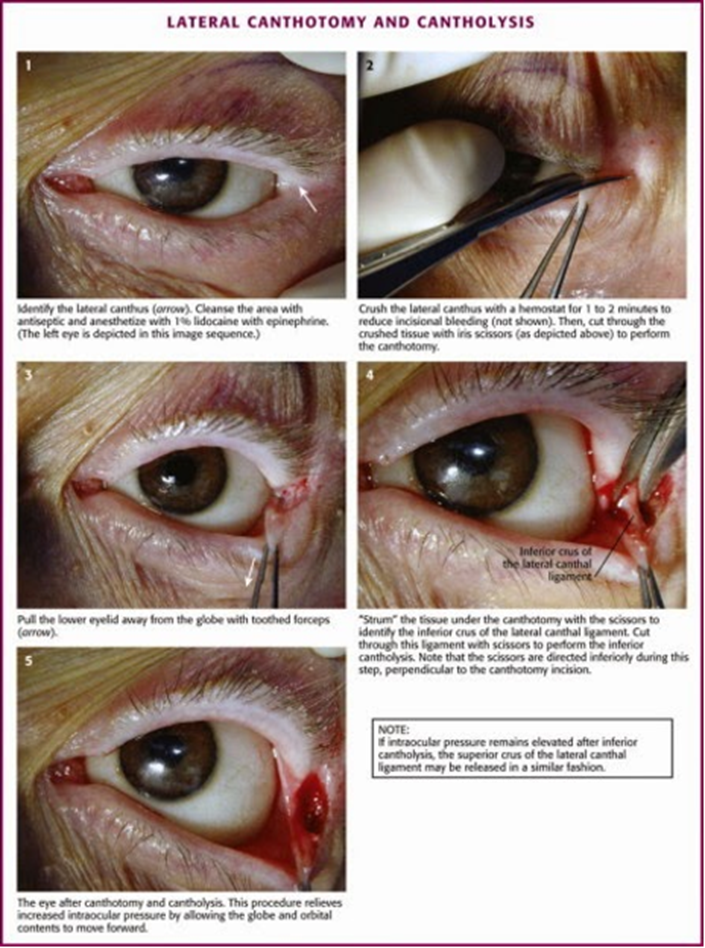
For a confirmed or suspected retrobulbar haemorrhage, urgent surgical intervention is required. It has been shown that time is a big indicator of prognosis for vision to return, and intervention should be carried out in <60 minutes.
Conservative management means continued risk of sight loss, and medical management (mannitol, dexamethasone or acetazolamide) should only be used to ‘fill the gap’ while waiting for surgical intervention.
The aim of surgical intervention is to release the pressure within the orbit, by allowing the globe and orbital septum to move in an anterior direction –effectively increasing the volume of the orbital compartment. It should be considered in all patients with suspected retrobulbar haemorrhage, especially with reduced visual acuity, raised intraocular pressure and a proptosed globe.
Lateral canthotomy and Cantholysis is a relatively simple procedure, however, comes with its risks and challenges, especially when the patient has significant soft tissue swelling and proptosis, causing distortion of the soft tissues.
Canthotomy and Cantholysis
1. Inject LA into the lateral canthus
2. Compress lateral canthus with straight haemostats (minimise bleeding)
3. Cut through all layers of tissue with iris scissors (approx. 1-2cm)
4. Retract lower eyelid to reveal lateral canthal tendon
5. Cut through inferior crus of lateral canthal ligament
Successful release of the ligament should allow for anterior movement of the globe – it should feel softer to the touch, and the lateral eyelid should be mobile.
In some situation where raised intra-orbital pressure persists, the superior canthal tendon can also be cut.
The patient should be reassessed for clinical improvement, in the same systematic approach as initially described.
Should there be no clinical improvement, further surgical intervention may be considered, such as formal exploration and drainage of the orbit.
Follow Up:
Patients who have suffered a retrobulbar haemorrhage are unlikely to be discharged following management – there will usually be admitted for a period of observation, or management of other injuries.
This allows for senior review of the patient during the light of day, and plans can be made for any necessary follow up or re-construction.
It is important to remember that the patient will be unable to blink effectively following the procedure, and so antibiotic ointment, lubricants, and a sterile dressing should be considered.
Referral to ophthalmology is crucial, even if an OMFS follow-up is planned. It is likely that your ophthalmology colleagues will want to see the patient within 24 hours, usually through eye-casualty the following day. Here they can more accurately assess and residual changes in IOP, and look at the globe in much more detail – it is likely that even following surgical intervention, VA may not return to pre-morbid levels – this may be a lingering complication of the retrobulbar haemorrhage, or due to co-existent retinal injury.
