
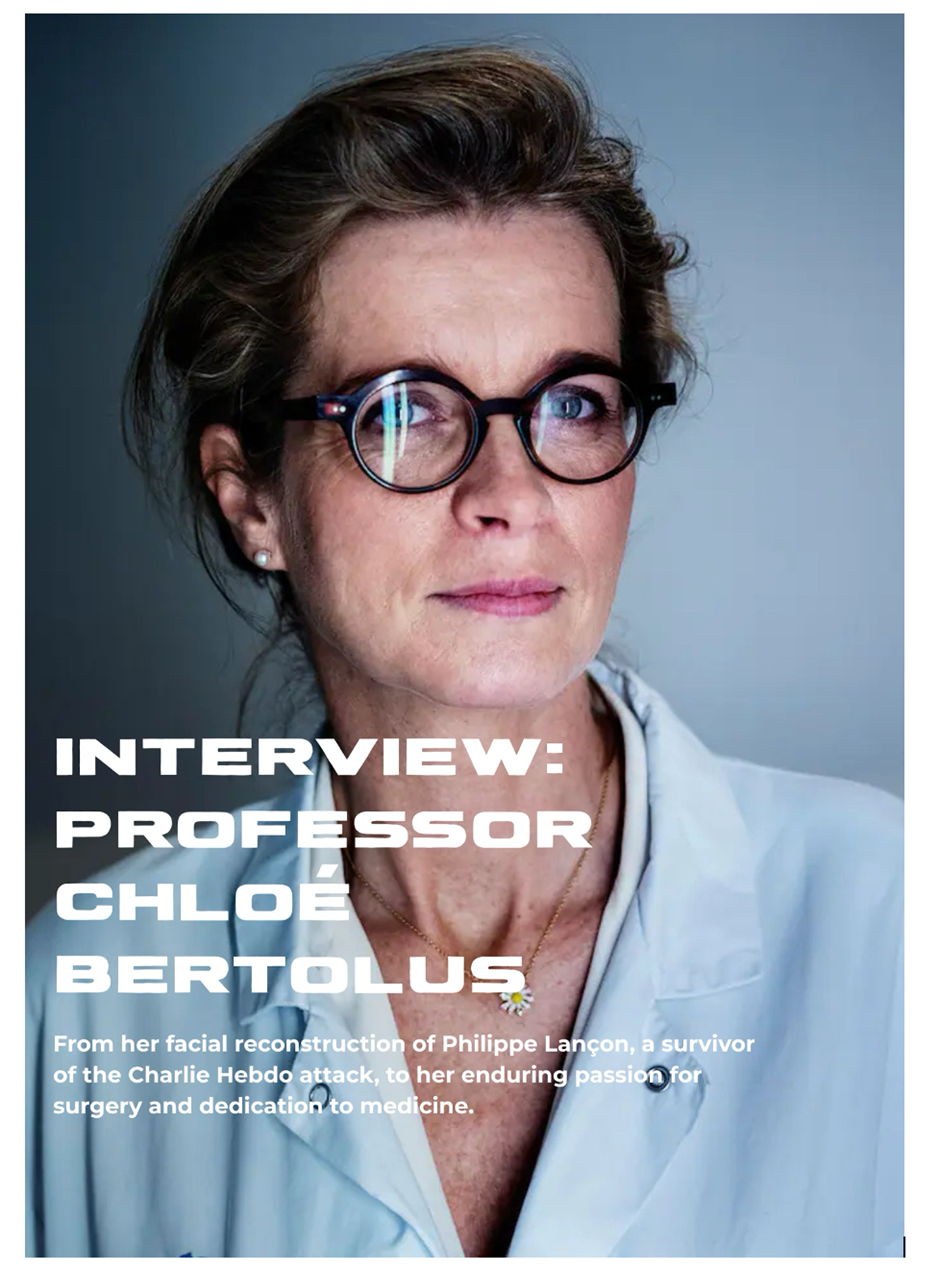
Interview: Professor Chloé Bertolus
Professor Chloé Bertolus is the Head of the Maxillo-Facial Surgery Department at Pitié-Salpêtrière Hospital in Paris. She gained public recognition in 2018 following the publication of Philippe Lançon’s memoir Le Lambeau (The Flap), in which she is depicted as a central figure responsible for his facial reconstruction and recovery. Lançon, a French journalist, survived the Charlie Hebdo terrorist attack in January 2015 in Paris.
Since then, Professor Bertolus has appeared in numerous media outlets, contributing to the popularization of maxillo-facial surgery and raising public awareness of the field. She is renowned for her forthright opinions on medicine, patient care, and the surgeon’s role.
In this conversation, Professor Bertolus reflects candidly on empathy in surgical practice, the weight of medical decision-making, and the evolving collaboration between French and British surgical communities.
It is an honour to interview Professor Bertolus, as our paths share notable similarities: both from Chambéry, France, having studied in London, and sharing a passion for surgery.

Global OMFS Training: How Does the UK Compare?
OMFS is still a relatively young specialty, and its development has differed across the world. What started as basic dentoalveolar surgery has grown into everything from microvascular reconstruction to major head & neck oncology, however, not every country has taken the same route to get there. Some demand dual degrees, others focus on dental-only training, and some have created hybrid models that offer flexible training pathways.
For those of us planning to pursue (or are currently training) OMFS in the UK, understanding these differences may help us appreciate why the UK pathway is structured the way it is, and what opportunities (or challenges) await if you're considering working abroad. Whether you stick with the UK grind or explore international options, being aware of the landscape helps you make informed choices about your career.