
Interview: Professor Chloé Bertolus
Interviewer: Andréa Poupard
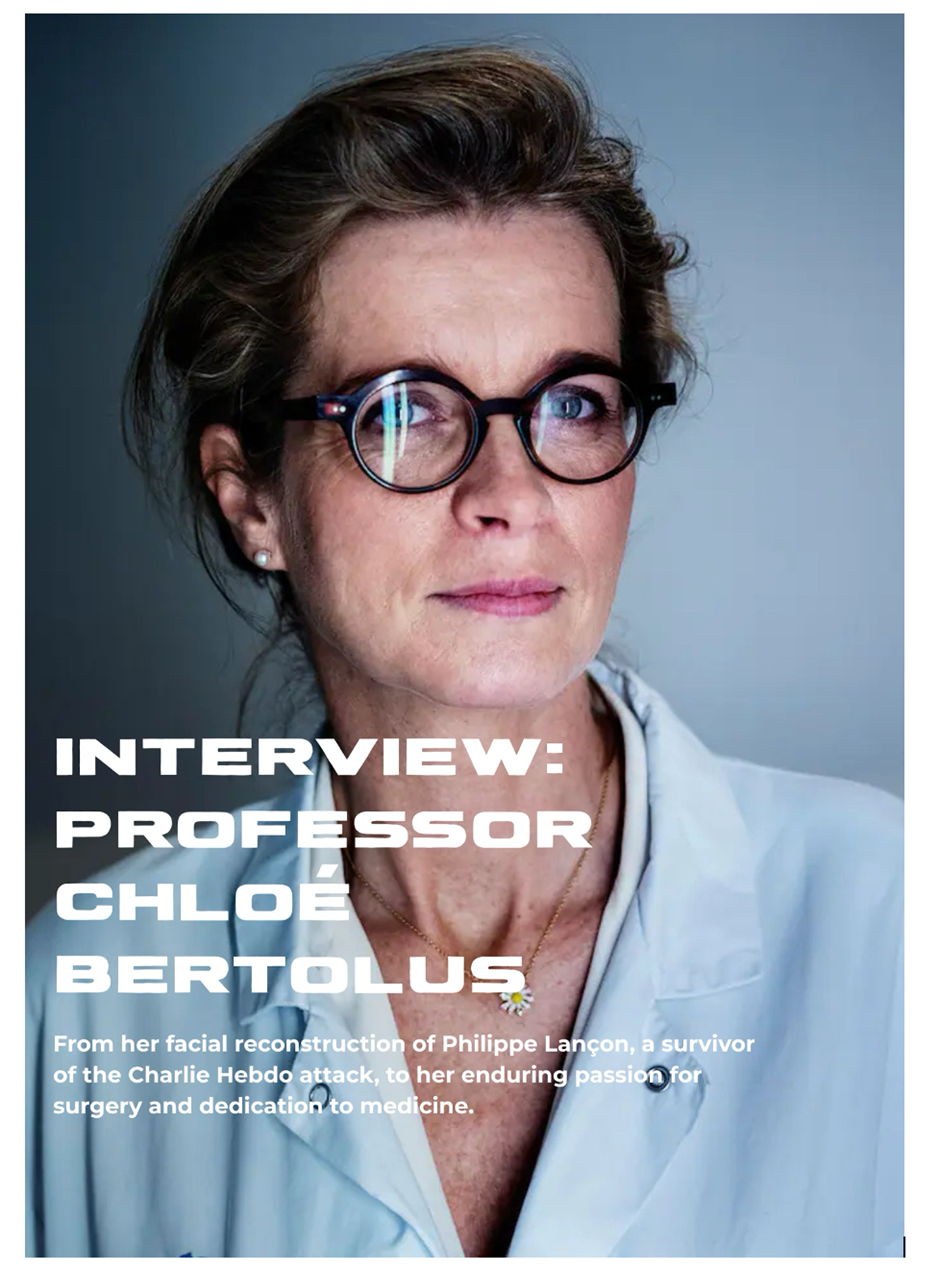
Professor Chloé Bertolus is the Head of the Maxillo-Facial Surgery Department at Pitié-Salpêtrière Hospital in Paris. She gained public recognition in 2018 following the publication of Philippe Lançon’s memoir Le Lambeau (The Flap), in which she is depicted as a central figure responsible for his facial reconstruction and recovery. Lançon, a French journalist, survived the Charlie Hebdo terrorist attack in January 2015 in Paris.
Since then, Professor Bertolus has appeared in numerous media outlets, contributing to the popularization of maxillo-facial surgery and raising public awareness of the field. She is renowned for her forthright opinions on medicine, patient care, and the surgeon’s role.
In this conversation, Professor Bertolus reflects candidly on empathy in surgical practice, the weight of medical decision-making, and the evolving collaboration between French and British surgical communities.
It is an honour to interview Professor Bertolus, as our paths share notable similarities: both from Chambéry, France, having studied in London, and sharing a passion for surgery.
AP: In his book Le Lambeau (The Flap), Philippe Lançon gave a detailed account of his injury and recovery. As a surgeon, what did you learn from seeing your work described through the eyes of a patient?
CB: Reading this book was, for me, quite chilling. To be honest, it was unsettling because it depended so much on the personality of the man who was injured that day. He’s a journalist, so he has a certain distance, an ability to observe and recount things that perhaps not everyone has. But I could see that our conversations were transcribed word for word. That was disturbing. As a result, there wasn’t much suspense for me in the book. I skimmed through it rather than reading it in detail, at least for the whole hospital section.
What struck me — and in a way, moved me — was the realization that in medicine, and perhaps especially in surgery, which is extremely intrusive in people’s lives since we literally open their bodies, nothing we say or do is insignificant. Every word we use, every gesture we make at a patient’s bedside is of paramount importance for their morale and for how they perceive their illness or injury.
I had always had an intuition about this. The Charlie Hebdo attacks didn’t happen when I was a young surgeon; I already had some experience. But this book made it overwhelmingly clear. It served as an additional reminder to be extraordinarily careful with the messages we deliver to patients.
It’s something I always tell my interns. I said it before, but now I emphasize it even more: Be careful. You may have seen thirty patients this morning in consultation, but for the patient sitting in front of you, this is their only consultation. If you tell them they have cancer, it may be the thirtieth time today you’ve said those words, but for them, it's their cancer — the one that may kill them. So be mindful of your presence, of the person you’re speaking to. And this account, this book, reinforced that lesson enormously for me.
AP: How do you maintain that empathy throughout a demanding career?
CB: I’m not convinced empathy can truly be taught. It feels more like a personality trait — you either have a natural concern for others or you don’t. That’s usually what draws people to medicine in the first place. So I’ve always found “empathy classes” a bit strange: putting a hand on a patient’s shoulder because you learned it in a course doesn’t create a real connection.
What can be learned, perhaps, is the discipline of paying attention to patients even when you’re preoccupied. You can remind yourself: “I have my own worries, but I need to be present for this person.”
When you’re a young surgeon, though, technique takes up all the space — and that’s normal. Before your first major procedures, you don’t sleep; you review anatomy and steps endlessly. At that stage, you’re not really thinking about the patient as a person, because if you did, you’d never dare operate. In theory there is always someone more experienced. In practice, of course, it works.
Later — for me it happened around forty — something shifts. The techniques become familiar, even the most difficult ones. You no longer worry about whether you can complete the operation. And that’s when you begin to think more about the patient: their job, their family situation, whether they’re isolated. You have more room to see the person behind the procedure.
That’s when empathy, or rather attention to others, becomes more visible. It grows as technical anxiety fades. And in surgery, a profession that takes years to master, that transformation simply takes time.
AP: What are the main challenges of managing ballistic facial trauma compared to other maxillofacial injuries?
CB: Surgery, strictly speaking, is technique. I’m often asked — especially after working in Ukraine — whether treating war-wounded patients moves me, considering what they’ve been through. But honestly, no. When someone arrives with half their face missing, my mind goes straight to the technical questions: What can be reconstructed? In what order? Do we start with the jaw, the nose, the eye? It becomes a problem-solving exercise.
Philippe Lançon’s case wasn’t technically complicated: he had no mandible, so we used a fibula to build one, placed implants, restored his teeth. There was no big debate; it was a straightforward reconstruction. So the book didn’t change my surgical approach.
What it did change was my sense of how much weight my words carry. I’ve never been the type to think everything I say is important — quite the opposite. But the book made me realize that patients take a doctor’s words very seriously.
As for ballistic trauma, the major difference compared to oncologic reconstruction is unpredictability. In cancer surgery, we control what we remove. It’s clean, deliberate. With ballistic injuries, destruction is chaotic: multiple areas are damaged, sometimes far from the point of impact, and always in a messy, irregular way.
In oncology, we know exactly what we’ll reconstruct before entering the OR — the jaw, the palate, the orbit — and we plan accordingly. With war injuries, even with CT scans, it’s extremely difficult to know the true extent of missing tissue until everything is opened and debrided. Scars hide massive retractions and deficits that can’t be predicted from the outside.
That’s why, with the patients I operated on in Ukraine, we often decided simply to open everything first and see what was actually missing. Only then could we choose the appropriate flap — skin, muscle, bone — and size it correctly.
Unlike oncology, you can’t run two teams simultaneously, one removing and one reconstructing, because you don’t know what you’re reconstructing until the full debridement is done. Ballistic trauma requires adapting in real time to extensive, unpredictable, multi-zone destruction. That’s the fundamental difference.
AP: You have mentioned that Mr. Lançon’s injury was not the most severe you had encountered from a surgical perspective. When facing more severe traumas, in what ways have you had to innovate? (For example, in terms of anastomosis, identifying alternative blood supply, delayed repair, or managing associated airway threats.)
CB: I’m not an innovator at all. I don’t think I’ve ever truly contributed anything new — it’s not in my nature. Most major advances in reconstruction were made in the 1980s and 1990s, especially the introduction of free flaps. My generation inherited that revolution.
In my department, though, there has been innovation. My deputy, Professor Thomas Schuman, holds the Materialise patents for 3D reconstruction planning — bone reconstruction guides, cutting guides, all the preparatory work we now take for granted. We started using these techniques in the late 2000s, and they have become almost industrialized. When I was an intern, doing one free flap a month was already a victory; now we sometimes do two a day. The real innovation, in a sense, is that microsurgery is no longer reserved for one revered expert — all senior residents learn it.
That’s why I believe facial reconstruction in oncology should become a standard, mandatory option. Patients who lose a jaw, tongue, or other structures should systematically be offered reconstruction. But this isn’t the case everywhere, in France or in England.
These surgeries still take a full day in the OR. We’ve reduced the average time from about ten hours to eight, but it will never be a two-hour operation. It requires two teams, multiple surgeons, and long hospital stays — economically, it’s a terrible model. But it’s essential for patients.
And in both France and England, despite all the financial strain on our health systems, severe trauma is still handled well by major centres. Surgeons want these cases; they allow us to maintain and improve our technique.
AP: From historical conflicts to modern attacks, maxillofacial surgeons often face war-like injuries. What key lessons from war surgery still apply today in emergency and reconstructive care? Also, You have mentioned that, even as civilian surgeons, we should be prepared to manage war-type injuries. How can we realistically prepare for this without being part of the military?
CB: All the basic principles of facial trauma surgery were invented during World War I: maintain airway and spaces, stop bleeding, then reconstruct skin and bone. The techniques were primitive, often requiring hundreds of operations per patient, but they laid the foundation. Today, free flaps allow us to reconstruct large areas of muscle and skin in a single operation, drastically reducing the number of surgeries.
Even as civilian surgeons, we need to be prepared for military-style injuries. In France, for example, we have introduced cross-disciplinary specialized training programs (FSTs) during residency. These bring together surgeons from different specialties — maxillofacial, thoracic, orthopedic — to train in war surgery and major trauma, including scenarios like terrorist attacks. Training is offered in collaboration with the military, providing practical experience even in peacetime, so surgeons can respond effectively when rare but critical injuries occur.
This preparation combines theory and practice, ensuring that both civilian and military surgeons can manage catastrophic injuries. The principle is the same: treat major trauma efficiently, whether it’s a bleeding spleen or a ruptured carotid artery, and follow the structured, historically proven steps of reconstruction.
AP: In the UK, research is strongly encouraged during training, sometimes at the expense of time in theatre. In your opinion, how does research make us better surgeons?
CB: This is a long-standing debate, and I decided to approach it by stepping outside my medical studies to pursue a theoretical PhD in biology — neuroscience, actually. Many questioned it, saying I should be learning surgery instead. But surgical skills are something you refine your whole life; early on, it’s more important to learn diagnosis and indications. For example, I once had a patient with a cyst at the tail of the eyebrow that had been misdiagnosed for over a year because the previous surgeon didn’t understand pediatricanatomy. Surgery isn’t just manual skill — it’s understanding what to do and when.
Research taught me imagination and freedom of thought in a way clinical work cannot. In the lab, you can explore ideas, question assumptions, and exercise creativity, which is constrained in the hospital for safety reasons. During my residency, I did my thesis while still operating, which was grueling, but I now encourage all my students to take a similar path. It strengthens clinical research skills: designing protocols, calculating sample sizes, analyzingdata, and learning to question everything.
For instance, three years ago at a sarcoma meeting, I challenged the assumption that chemotherapy worked for osteosarcomas in our patients. Reviewing surgical specimens, we saw no necrosis, contrary to published expectations. This kind of fundamental questioning — which you develop in lab research — makes you a better doctor and surgeon, because surgery is ultimately medicine applied, not just technique.
Medicine is empirical; it’s an art as well as a science. Seeing a patient and performing a procedure successfully doesn’t automatically mean the technique is the best — only that it works in your hands. Fundamental research instills rigor, critical thinking, and the habit of questioning the established ways, which is invaluable for a lifelong surgical career.
AP: UK maxillofacial surgeons are required to hold both medical and dental degrees, unlike in France. How do you view this difference, and what do you think you might have gained from a dental degree?
CB: In my opinion, spending years on a dental degree before maxillofacial surgery is largely a waste of time. If I need advice about a tooth, I ask a dentist; if I need liver advice, I ask a hepatologist. For maxillofacial surgery, understanding the jaws, teeth, and oral structures is part of medicine, not general dentistry. I know how to take impressions and order dentures, but the world’s first face transplant wasn’t done by a dentist — it was performed by a surgeon with solid medical and surgical training.
In England, maxillofacial training begins with rotations in surgery and internal medicine, then moves straight into the specialty. I believe a solid foundation in medicine and surgery — including orthopedics, vascular surgery, neurosurgery — is far more useful than years spent on general dentistry. Dentistry-focused years are time-consuming, expensive, and largely unnecessary for becoming a competent surgeon.
This is particularly evident when comparing training in Europe to the former Soviet bloc. In places like Romania or Ukraine, surgeons often have only three years of dentistry plus a year of specialization. They may have custom plates for facial fractures, but in practice, they often work with basic materials due to resource limitations. Surgery is not manual labor; it is medical thinking and judgment. Being a doctor first, with research and rigorous training, provides the intellectual foundation essential for effective surgical practice.
AP: What opportunities do you see for Franco-British collaboration in maxillofacial surgery and research?
CB: Thanks to President André Chêne of the French Society of Maxillofacial Surgery, we have reestablished ties with England, which had grown a bit distant—not out of hostility, but due to a lack of personal contact. At the last Paris congress, we held a British session with the British Maxillo-Facial Organisation, which led to our participation in the English Congress last June. These exchanges are less about what we present and more about building relationships.
I have a personal affection for the UK, having completed my high school diploma at the French high school in London. We are always happy to receive British interns and send ours there, recognizing the quality of education in both countries. Collaborations also ensure rigorous, comparable studies, especially for rare diseases like sarcomas.
Writing articles in English is challenging, especially switching from French grammar, but having bilingual students helps. Despite years in England, I still struggle with certain structures, and I may revisit English more seriously after retirement.
AP: In a context where there is a lot of discussion about patient-centered care and shared decision-making, you stated that it is not the patient who should choose the surgical procedure, but the doctor. How do you reconcile your perspective with the growing demand for patient participation in medical decisions?
CB: I believe there is something superficial and almost inhumane about asking patients to choose their own treatment. In my opinion, it can feel like a scam because it puts an enormous burden on people who are already in a vulnerable position. Even among medical staff with decades of experience, reaching a consensus on the best approach can be very difficult. There is nothing obvious about determining the “best solution” for a patient. That is why I think the responsibility should lie with the doctor. Patients should be fully informed about procedures, risks, and alternatives, but it is ultimately the doctor who must choose the treatment plan. For example, I once treated a 90-year-old woman with tongue cancer. She and her son entrusted me entirely to make decisions for her care. This relieved them of the heavy burden of choice and allowed us to act decisively for her well-being. Medicine, in my view, involves “the anxiety of choice.” It is the doctor who must bear the anxiety of deciding what is best for the patient, not offload that responsibility onto the patient or their family.
AP: How do you handle cultural differences, psychological factors, and communication challenges when making treatment decisions?
CB: Patients’ decisions are often influenced by unconscious psychological factors, personal history, and past experiences. I recall a man who refused eye surgery because, for seventy years, he felt guilty about an accident from his childhood in which his sister lost an eye. He viewed the surgery as a symbolic act of atonement and would not consent, even though the operation was medically appropriate. Language barriers are another practical challenge, particularly during emergencies. I once reassured an elderly Greek woman who was panicking in the recovery room by speaking just a few words in Greek, which helped her feel calm and understood. Cultural differences are real, but I have never encountered an insurmountable barrier. Once communication is established, consensus on treatment and patient care is usually achievable. In urgent situations, such as at night or in intensive care, decisions must be made clearly and decisively, leaving little room for prolonged discussion. The doctor must combine medical expertise, ethical responsibility, and human understanding while guiding patients and their families through these difficult choices.
AP: Finally, what advice would you give to young surgeons who want to combine clinical excellence, research, and humanitarian work?
CB: Well, to go abroad, you need to be very well trained. I think you shouldn’t go just to train. That’s not a good mindset, in my opinion. To train properly, you have to go with real added value, meaning you go to do things that the local teams don’t know how to do. That way, the help provided is truly honest.
If you want to practice surgery later, you can’t stay on a humanitarian mission providing basic care. That’s a different purpose. If you claim to be part of a surgical mission, you have to go and perform procedures you know very well to offer real added value. Otherwise, it isn’t honest. That’s my ethical stance. For example, if we go to Senegal to operate on patients with giant ameloblastomas—tumors that are extremely deforming and rarely treated there—we perform free flaps, which no one else does. In Senegal, we remove the mandible and replace it with a fibula, truly changing patients’ lives.
Beyond that, I think it’s crucial to strive every day to be fully present in what we do, to be in the moment. As responsibilities grow, it’s easy to get distracted or let other concerns intrude. But being fully present in a consultation makes us more efficient. You have to stay organized, and that’s a daily struggle for me because I’m naturally disorganized. The key is not letting anxiety about external things overwhelm you so that you can be fully there for the patient and provide real advice.
Regarding research, I haven’t mentioned that before, but I took a year off to do my Master’s, which at the time was called a DEA. I was in Nicole de Douarin’s lab—the woman who invented chimeras in embryology. For the first time in eight years, during my internship, I wasn’t seeing sick patients. I was working with chicken embryos, operating on eggs. It had a certain lightness to it. I remember once telling my supervisor, “I can’t take it anymore; it’s horrible,” and she simply threw a tray of 24 eggs on the floor, saying, “It’s okay, they’re not patients.” That lightheartedness reminded me that medicine is serious, but you also need to be able to enjoy your work and not carry all the world’s misery on your shoulders.
Above all, we must remember that we are not merely technicians. Yes, techniques are important, but we apply them to human beings. That’s why medicine is so vital: diagnosis, the right indication, and perfect control of side effects or complications. If we do that, we avoid ethical mistakes and stay honest with our passions and ourselves. Knowing our limits—when to refer a patient, for example—is fundamental.
I also believe that taking responsibility is essential. If we make a treatment decision in good faith and the patient does not survive, we must stand by it, knowing we acted responsibly. There are situations where resuscitation specialists may advise against operating on a 90-year-old because she wouldn’t survive intensive care, but without surgery, she wouldn’t survive at all. In such cases, operating may be the more humane option. You need courage to do this work and accept the outcomes.
Medicine is more than a job; it’s a calling. Even outside the hospital, you remain a doctor. This mindset also extends to international collaboration. While language barriers exist, once overcome, consensus on patient care is possible. In terms of visiting or working in hospitals abroad, opportunities exist for observers or for interns with real responsibilities, and such experiences are invaluable. I’m president of the College of Medicine of the Hospitals of Paris, which brings in about thirty trainees each year, primarily from the French-speaking world, to participate in full internship responsibilities. Visitors can see the hospital workflow, but hands-on experience is crucial.
Ultimately, in both surgery and research, the goal is to be fully present, ethically honest, and to take responsibility. Medicine requires judgment, courage, and continual reflection, as well as a willingness to express opinions even if they might not be popular. That’s my philosophy, and it’s how I reconcile the various dimensions of my professional life.
The Interview was conducted on the 10th of September 2025 by Dr Andréa Poupard (West Midlands Regional Rep)
