
Overview of Management of Penetrating Neck Injury
Author: Jane Murray
This is intended to provide an overview of the assessment and initial management of penetrating neck injury for OMFS first on call based on RCS England 2017 Guidelines1. It is important to ensure local policies regarding which specialties manage these injuries are followed and to involve seniors early. Links have been provided to additional sources details of surgical intervention.
Key Terms
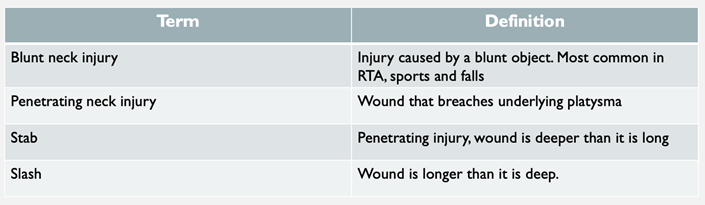
What is a penetrating neck injury?
• An injury to the neck which has breached the underlying platysma muscle
• If platysma is breached higher risk of injury to deep aerodigestive and vascular structures
• If platysma not breached the injury is superficial and likely not harmful
• 5-10% of all trauma cases2
• Most commonly caused by stab wounds from assault, gunshot wounds and RTAs3
Note on Blunt Neck Trauma
• Usual causes: RTA, falling from height, sports injuries, assault
• At risk structures: airway and C spine
• Can have both blunt and penetrating neck injury
• Immobilisation of C spine required
Anatomy Considerations
Platysma
· Thin, sheet like muscle found within the subcutaneous tissue of the anterior neck. Lies between superficial and deep fascia.
· Origin: skin/ fascia of infra- and supraclavicular regions
· Insertion: Lower border of mandible, skin of buccal/ cheek region, lower lip, modiolus, orbicularis oris muscle
Vascular Injury:
• Arterial injury seen in 25% of penetrating neck injuries1
• Partial or complete occlusion, dissection, pseudoaneurysm, extravasation of blood, arteriovenous fistula formation
• Structures at risk: carotid artery, vertebral artery, jugular veins
• Combined carotid and vertebral artery injuries= major haemorrhage and neurological concern
Aerodigestive Injuries:
• Seen in up to 30% of penetrating neck injuries1
• Laryngotracheal more common than pharyngo-oseaphageal
Neurological:
• Spinal cord (rare especially if low velocity injury e.g. stab)
• CN VII-XII, sympathetic chain, peripheral nerve roots, brachial plexus
Zones of the Neck4
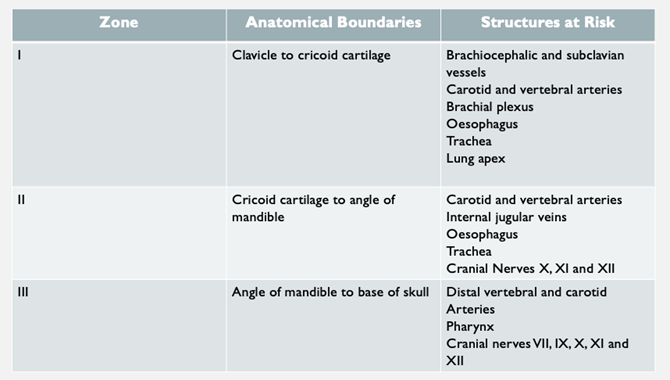
The RCS England guidelines1 recommended a move away from a zonal approach towards an imaging guided approach (multidetector helical computed tomography with angiography) in stable to reduce negative neck explorations.
It can be helpful to use this approach to help with thinking about the structures that may be involved
Management of Penetrating Neck Injury as a First On-Call
The Call
· You may be prealerted prior to the patient arriving
· It may not be possible to get a lot of information about the patient or the injury but if possible it is useful to find out
o Patient details
o Mechanism of injury
o Location of injury
o Estimated blood loss
o Stability of the patient
o Active bleeding
o Any significant medical history
o Any other injuries
· Inform your second on call as soon as possible especially when they are not on site
· When to patient arrives go to assess them urgently
In A&E
Primary Survey (may have been done prior to your arrival):
· A-E approach
o Some of the literature recommends a <C>ABCDE approach as exsanguinating haemorrhage can kill more quickly than suboptimal airway so this should be controlled first in the case of a penetrating neck injury (exsanguination accounts for 50% of mortality from penetrating neck injuries)3
· Airway: hoarseness, stridor, dyspnoea, subcutaneous emphysema, bubbling of blood from inside wound, haemoptysis. Indications for surgical airway: orotracheal intubation unsuccessful, massive upper airway distortion, massive midface trauma, inability to visualise glottis (heavy bleeding/ oedema/ anatomical disruption)
· Breathing: consider chest x-ray (after initial assessment) if pneumothorax suspected
· Circulation: pressure, trauma clips, vascular access (opposite to side of injury), foley balloon tamponade
· Disability: GCS
· Exposure: assess for other injuries
Secondary Survey:
· Usually where OMFS would be involved
· History
· Head to toe exam
· If life threatening injury identified, lifesaving interventions initiated
Assessing the Injury
· Location, size, active bleeding, debris/ contamination
· Do not blindly explore the wound e.g. put fingers/ clips inside as this can dislodge clots leading to haemorrhage
· Platysma intact superficial
· Platysma breached penetrating management based on patient’s signs and symptoms
C- Spine Considerations
• Cervical spine immobilisation is not routinely recommended
o Incidence of unstable C spine fracture very low in penetrating neck injury
o Collars may obscure clinical signs and impair intubation
• Exception: focal neurology (e.g. weakness in arm or leg, changes in speech/ vision/ hearing, uncoordinated movements or high suspicion of C spine injury
• Consider in high impact injuries e.g. gunshot, RTA
Foley Balloon Tamponade:
· Insert Foley catheter into wound
· Inflate balloon with 10-15ml of water until resistance is met
· Clamp catheter
· Suture neck
· If successful allows time for angiography to identify source of bleeding
When to go to Theatre and Bypass Imaging
Haemodynamically Unstable:
· Weak pulse
· Hypotension
· Deteriorating GCS
Signs of Penetrating Injury to Key Structure:
· Air bubbling from wound
· Subcutaneous emphysema
· Stridor
· Rapidly expanding or pulsatile haematoma
· Haemoptysis (coughing up blood)
· Active brisk bleeding
· Shock refractory to fluid resuscitation
· Neurological deficits
· Absent/ weak radial pulse
· Airway compromise
· Audible bruit/ palpable thrill (whooshing/ buzzing)
· Hoarseness
Stable Patients
· Multi-detector CT angiography
o Highly sensitive and specific for detecting vascular, laryngotrachial and many pharyngo-oesophageal injuries
o Eliminates need for multiple imaging modalities
o Can provide information on trajectory of wound and suggest whether imaging of thorax required
o Results in decrease in need for formal neck exploration and exploratory surgery
o May miss pharyngo-oesophageal injuries
· May wish to consider additional pharyngo-oesophageal investigations
· MDCTA positive direct angiography, bronchoscopy, oesophoscopy. If positive for surgical exploration/ repair.
· If MDCTA positive can observe patient and consider contrast oesophagraphy
Details of Surgical Management can be found:
· RCS England Guidelines : https://publishing.rcseng.ac.uk/doi/full/10.1308/rcsann.2017.0191
· Trauma Surgery and Acute Care Open article: https://tsaco.bmj.com/content/10/1/e001619
· These sources also have useful diagrams and flow charts which were not able to be included in the article due to licencing requirements.
References:
1. Nowicki, J.L., Stew, B., Ooi, E. 2018. Penetrating neck injuries: a guide to evaluation and management. The Annals of The Royal College of Surgeons of England. [Online]. 100(1), pp.6-11. [Accessed 2 December 2025]. Available from: https://doi.org/10.1308/rcsann.2017.0191
2. Vishwanatha, B., Sagayaraj, A., Huddar, S. G., Kumar, P., Datta, R. K. (2007). Penetrating neck injuries. Indian journal of otolaryngology and head and neck surgery : official publication of the Association of Otolaryngologists of India. [Online]. 59(3), pp.221–224. [Accessed 2 December 2025]. Available from: https://doi.org/10.1007/s12070-007-0065-7
3. Burgess, C. A., Dale, O. T., Almeyda, R., & Corbridge, R. J. (2012). An evidence based review of the assessment and management of penetrating neck trauma. Clinical otolaryngology : official journal of ENT-UK ; official journal of Netherlands Society for Oto-Rhino-Laryngology & Cervico-Facial Surgery. [Online]. 37(1), pp.44–52. [Accessed 2 December 2025]. Available from: https://doi.org/10.1111/j.1749-4486.2011.02422.x
4. Loss L, Henry R, White A, Matsushima K, Barrett C, Lammers D, et al. (2025) Penetrating neck trauma: a comprehensive review. Trauma Surgery & Acute Care Open. [Online]. 10 (1). [Accessed 2 December 2025] Available from: https://doi.org/10.1136/tsaco-2024-001619
