
The JTG Annual Essay Prize is now in its second year and as with last year, we received multiple excellent essays this year.
Entrants were asked to submit an essay to answer the question: “Centralised or Localised? Reassessing the Optimal Recruitment Model for UK OMFS Training.”
The winning entry was chosen after a competitive marking process and we are delighted to announce Ruby Fussell as the winner. Her essay can be read in full below.
Better the Devil You Don’t Know? The Interview before the Interview, The “Nepo-Trainee” and The National Match.
What are we really looking for?
The apparent choice between centralised and localised recruitment is a false binary. Recruitment is not a single process but a series of functions: eligibility, assessment, ranking and allocation. These need not occur at the same level.
Nor is an ‘optimal’ system necessarily synonymous with the ‘fairest’ interview. Standardisation may improve procedural equality and reliability without necessarily improving prediction of future performance [1]. For OMFS, an optimal system should fairly identify, develop and retain those most likely to become excellent surgeons, while matching them effectively to training programmes.
This does not justify a return to patronage. Familiarity and the historical ‘boys’ club’ remain powerful arguments against purely local selection. Yet longitudinal local knowledge of candidates may contain valuable information that a single national interview cannot capture. The challenge is therefore not choosing between national and local recruitment but combining their useful attributes without reproducing their weaknesses.
Perhaps the solution is a ‘Goldilocks’ model that cherry-picks and combines national standards and regional selection, whilst adding novel concepts like longitudinal interviewing with established systems such as reciprocal preferencing and national matching.
Why are we always complaining about what we have now?
OMFS specialty recruitment has been centralised since 2010 [2] and has its obvious strengths: common criteria improve comparability, national access prevents geographical incumbency, and distance between candidates and selectors limits patronage in a small specialty. National benchmarking also establishes an agreed threshold for appointability. These principles are worth protecting. But a system can be procedurally fair without being equally effective at predicting future performance or candidate–programme compatibility.
Another sacred cow is the presumed effectiveness of a conventional interview for selection, and broader medical selection literature cautions us on placing too much faith in it. Patterson et al found better evidence for several alternatives, including academic records, MMIs, aptitude tests, SJTs and selection centres, while also highlighting how much research has concentrated on reliability rather than meaningful prediction of future performance [1]. A recent systematic review of graduate medical education interviews similarly found limited evidence for the predictive validity of conventional interviews and substantial scope for bias [3].
This exposes another weakness of the centralised interview: it samples performance at an artificial moment. Surgical training depends heavily on typical performance over time. Judgement, reliability, teamwork, communication, technical development, professionalism, resilience and response to feedback are not episodic qualities. A candidate can rehearse how to describe them to an interviewer, whereas during an extended period of working alongside someone, a colleague can experience whether they truly possess them. The danger is that increasingly sophisticated standardisation produces an increasingly precise answer to the wrong question. The best interviewee is not necessarily the best future surgeon.
What do we miss about ‘old-fashioned’ selection?
The major draw of local recruitment is that it restores context and mutual choice. Trainers have real-world experience of how a candidate functions in the workplace, while candidates can make informed choices about programmes whose case mix, culture, geography and subspecialty opportunities suit their ambitions. Selection begins to concern compatibility rather than abstract national position. There is an obvious parallel at the other end of training: consultant appointments are inherently local, contextual and reciprocal.
This has particular relevance to OMFS, a unique and small specialty. Firstly, entry to higher surgical training follows two degrees and a prolonged postgraduate pathway, by which points geographical preference may reflect partners, children, housing, research collaborations and established professional networks. Sharma et al surveyed 306 members of the OMFS community, and of 250 expressing an opinion, 62% supported local selection, and 56% supported local selection with national benchmarking [2]. More broadly, UK cohort data demonstrate substantial geographical continuity between medical education, training and eventual career destination [4]. Geography should not override merit, but it would be equally simplistic to pretend it has no relevance to recruitment, retention or future workforce distribution.
Secondly, OMFS is small enough that being known is often unavoidable. Post-CCT candidates may already be familiar to the unit they eventually join, through training, fellowship or previous collaboration. It seems inconsistent to regard such contextual knowledge as valuable when recruiting a lifelong consultant colleague, yet intrinsically illegitimate when selecting a trainee.
Local selection, however, does create its own problem, an issue this essay has coined the ‘Nepo-Trainee’. A familiar candidate may have spent years working with future selectors, accumulated projects and publications within their department, and established a positive reputation of being “a good pair of hands”, a reassuring reputation of being a “known quantity” or merely “better the devil you know”. This need not involve conscious nepotism: familiarity itself influences judgement, and an external candidate cannot reproduce years of informal exposure during a forty-minute interview.
The answer, therefore, may not be to discard local knowledge, but to convert familiarity into structured evidence while preserving genuine opportunity for external candidates.
Can we be interviewed for years before the interview?
Developing into a valuable OMFS surgeon is a long game, so characteristics that manifest longitudinally should, where possible, be assessed longitudinally. If we care about how someone behaves over time, it seems odd to assess this mainly by asking them about it on one day. Rather than requiring candidates to describe their reliability, teamwork or response to feedback, these attributes could be observed repeatedly across different assessors and working environments.
One approach would be a portable ‘longitudinal interview passport’ accumulated before recruitment. OMFS is unusually suited to this because applicants spend several years before higher surgical training completing a second degree alongside clinical posts. This period provides an opportunity to collect structured evidence of workplace performance rather than relying solely on performance at interview.
However, this must not become an elaborate consultant reference, another ePortfolio of meaningless WBAs, or a reward for accumulating projects with future selectors. Supervisor assessment is itself subjective and context-dependent. McGill et al demonstrated substantial measurement error in workplace supervisor ratings, with multiple observations required to achieve acceptable reliability [5]. Narrative references are also vulnerable to bias, while greater standardisation may reduce some of these differences [6].
A longitudinal model would therefore require nationally defined domains, structured assessments, multiple assessors and moderation. A stripped-back, portable version of the ISCP structure could provide such evidence while remaining independent of any particular region. Crucially, the record would belong to the candidate and travel with them, allowing an external applicant to demonstrate longitudinal performance without needing a local reputation. Without these safeguards, the ‘longitudinal interview’ risks simply professionalising the Nepo-Trainee.
Nor should longitudinal evidence replace national assessment. Different selection methods capture different information: situational judgement tests, for example, show modest predictive validity for interpersonal workplace outcomes and may add information beyond knowledge-based assessments [7]. The aim should therefore be triangulation rather than the search for a single perfect selection instrument.
Should we stop ranking and start matching?
The more fundamental change would be conceptual. Current recruitment assumes that appointable candidates can be meaningfully ordered from best to worst on a single national ranking. Yet excellent trainees have different strengths, just as excellent programmes offer different training opportunities. Beyond a threshold of appointability, the more useful question may therefore be not simply ‘who is best?’, but ‘who is best matched to where?’
A hybrid system could separate recruitment into distinct stages. Eligibility and a minimum threshold for appointability would remain nationally defined, with longitudinal evidence and national assessments contributing to a comparable candidate profile. Appointable candidates could then enter structured regional selection, allowing programmes to assess candidates while candidates scrutinise programmes in return. Both would rank their preferences, with a national algorithmic match determining final allocation (Figure 1).
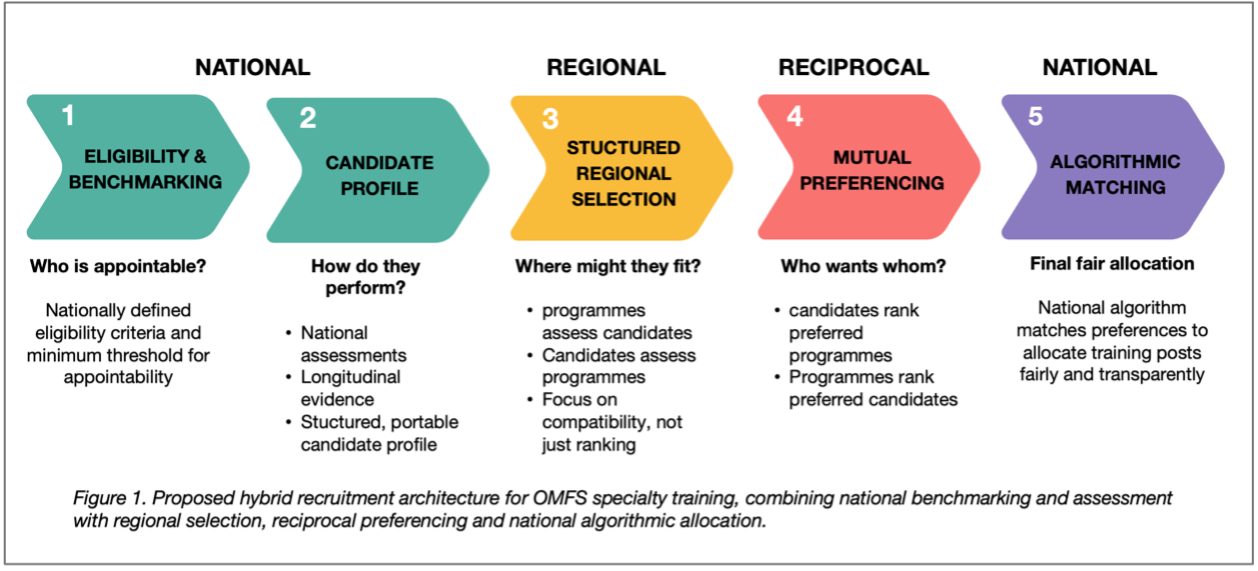
There is precedent for separating selection from allocation. The US National Resident Matching Program combines programme-level interviews with reciprocal ranking and an applicant-proposing matching algorithm [8]. The model need not be imported wholesale to demonstrate the principle, but selection and allocation certainly do not have to be the same process. Why not let trainees preference programmes and programmes preference trainees, then allow the algorithm to arrange the not-so-blind date? Closer to home, NIHR Academic Clinical Fellowship recruitment allows regional recruitment to remain conditional on satisfying national clinical benchmarking requirements [9]. Sharma et al similarly identified a ‘Walport-style’ model of local selection with national benchmarking as a potential model for OMFS [2]. Regional rather than individual-unit selection could provide an additional safeguard against departmental patronage.
Such a system would inevitably introduce complexity. Longitudinal assessment is resource-intensive, regional selection could introduce variable standards, and ‘fit’ could become a respectable shorthand for selecting candidates who resemble the existing department. Nor can an algorithm rescue poor underlying assessment. National moderation and evaluation would therefore remain essential. A pilot could test recruitment measures against subsequent ARCP progression, examination performance, training completion, professional concerns, trainee satisfaction and regional retention. A recruitment process that demands evidence of progression from its trainees should be equally willing to demonstrate evidence of its own predictive validity.
Not too hot, not too cold…
Centralised versus localised is the wrong question, as they each solve different problems. Centralisation is powerful where comparability, access, benchmarking and protection against patronage matter. Local or regional involvement becomes valuable where context, geographical sustainability and candidate–programme compatibility matter. Neither should be expected to perform every function of recruitment.
The optimal OMFS model should therefore be neither centralised nor localised in the conventional sense. Nationally defined eligibility and benchmarking should establish who is appointable; structured longitudinal evidence could be a better representation of how candidates actually perform, regional selection could assess compatibility, reciprocal ranking could express genuine preference and a national algorithm could make the final match.
Such a system would require testing rather than faith, but it reframes the problem appropriately. The ambition should not simply be to create the fairest possible interview, nor to resurrect the familiar local appointment. It should be to preserve national defensibility while recovering local intelligence, avoid ‘the Nepo-Trainee’ without discarding meaningful knowledge of individuals, and move OMFS recruitment from ranking excellent candidates towards matching them intelligently with the programmes in which they are most likely to succeed.
by Ruby Fussell
References
Patterson F, Knight A, Dowell J, Nicholson S, Cousans F, Cleland J. How effective are selection methods in medical education? A systematic review. Med Educ. 2016;50(1):36-60. doi:10.1111/medu.12817.
Sharma D, Douglas J, Begley A, Hutchison I, Magennis P. United Kingdom oral and maxillofacial surgeons support changes to current specialty recruitment process, which could include ‘Walport’ style local selection and national benchmarking. Br J Oral Maxillofac Surg. 2024;62(5):483-488. doi:10.1016/j.bjoms.2024.03.002.
Lin JC, Hu DJ, Scott IU, Greenberg PB. Evidence-based practices for interviewing graduate medical education applicants: a systematic review. J Grad Med Educ. 2024;16(2):151-165. doi:10.4300/JGME-D-23-00115.1.
Goldacre M, Davidson J, Maisonneuve J, Lambert T. Geographical movement of doctors from education to training and eventual career post: UK cohort studies. J R Soc Med. 2013;106(3):96-104. doi:10.1177/0141076812472617.
McGill DA, van der Vleuten CPM, Clarke MJ. Supervisor assessment of clinical and professional competence of medical trainees: a reliability study using workplace data and a focused analytical literature review. Adv Health Sci Educ Theory Pract. 2011;16(3):405-425. doi:10.1007/s10459-011-9296-1.
Deshpande SR, Lepore G, Wieland L, Kogan JR. Racial and ethnic bias in letters of recommendation in academic medicine: a systematic review. Acad Med. 2024;99(9):1032-1037. doi:10.1097/ACM.0000000000005688.
Webster ES, Paton LW, Crampton PES, Tiffin PA. Situational judgement test validity for selection: a systematic review and meta-analysis. Med Educ. 2020;54(10):888-902. doi:10.1111/medu.14201.
National Resident Matching Program. How the matching algorithm works. Washington (DC): NRMP; [cited Aug 29 2026]. Available from: NRMP website (https://www.nrmp.org/)
NHS England. Academic Clinical Fellowships: academic recruitment pathways [Internet]. Medical Hub. [cited Aug 29 2026]. Available from: NHS England Medical Hub. (https://medical.hee.nhs.uk/medical-training-recruitment/medical-specialty-training/academic-recruitment/academic-recruitment-pathways/academic-clinical-fellowships-acf)
