
2025 Essay Competition Winner: Fixing the Middle Mile - Turning Early Enthusiasm into Lasting Commitment
Essay Topic: “With increasing competition ratios for surgical training the specialty of OMFS is still underrecruiting. What could be done to rectify the current recruitment crisis and secure our future workforce?”
Word count (excluding references, tables, and figures): 1593
Introduction
Oral and maxillofacial surgery (OMFS) stands at the intersection of medicine and dentistry, uniquely encompassing head and neck oncology, complex trauma, craniofacial deformity, cleft surgery, and reconstructive practice. Its breadth and impact should make it one of the most attractive specialties. OMFS provides essential NHS services: managing facial trauma in major trauma centres, treating oral and head and neck cancers, performing emergency airway interventions, and delivering life-changing reconstructive operations. Yet despite this crucial role, the specialty struggles to attract and retain sufficient trainees. The Junior Trainees Group (JTG) of BAOMS recently reported that only around 50% of ST3 posts were filled in recent cycles (1). This creates serious risks for cancer pathways, trauma services, and emergency coverage.
This is not a new problem. For over two decades, UK OMFS has faced shortages, with consultant numbers per capita lagging behind European comparators. By 2010, reliance on locums was already commonplace. Compared to neurosurgery and plastic surgery—both long, demanding, and competitive training routes—OMFS has failed to convert early enthusiasm into a sustainable workforce. In countries such as the US and much of Europe, OMFS training follows integrated medical–dental tracks, avoiding the prolonged 'stop–start' pattern seen in the UK. OMFS attracts strong interest at ST1 and for second-degree places (1,3), and national recruitment reports corroborate high early-stage competition and fill (2), yet enthusiasm dissipates before ST3 (5). The true challenge is the 'middle mile': systemic choke points between second degree and higher specialty training where appointable candidates are lost. Fixing this middle mile is key to securing the OMFS workforce. The consequences of failing to address this are stark: delays in head and neck cancer treatment reduce survival rates, while trauma patients face longer waits and poorer functional outcomes compared to specialties with secure training pipelines. Without decisive action, the specialty faces not only service disruption but also long-term reputational damage, with fewer graduates considering OMFS as a viable option compared to more straightforward surgical careers. This underscores the need for systemic, not piecemeal, reform.
1. The Recruitment Paradox: Demand Exists, Supply Leaks Away
At ST1, OMFS posts are often competitive, and controlled second-degree places can attract high application ratios, in some cases exceeding 20:1 (3).
2. Diagnosing the Middle Mile: Four Interlinked Frictions
i) Geographical rigidity
OMFS trainees are often older, with families and financial commitments. Centralised allocation frequently requires relocation, leading many to decline offers. A 2024 survey confirmed that most UK OMFS surgeons favour 'Walport-style' local selection with national benchmarking to improve continuity (6).
ii) Pathway duplication and inefficiency
The 2024 JTG State of Play report documented duplicated competencies, disjointed curricula, and excessive bureaucracy that sap morale (1).
iii) Financial drag of dual qualification
Dual qualification imposes a uniquely heavy burden. Tuition fees of £9,000 per year, combined with lost NHS salary (£30–40,000 annually), mean the second degree can cost close to £100,000. This disproportionately deters candidates from less affluent backgrounds, reducing diversity (1).
iv) Unequal early exposure
Medical-first graduates encounter fewer OMFS opportunities than their dental counterparts. Emms et al. found England has over 11 times more OMFS posts for dental graduates than for medical graduates (7).
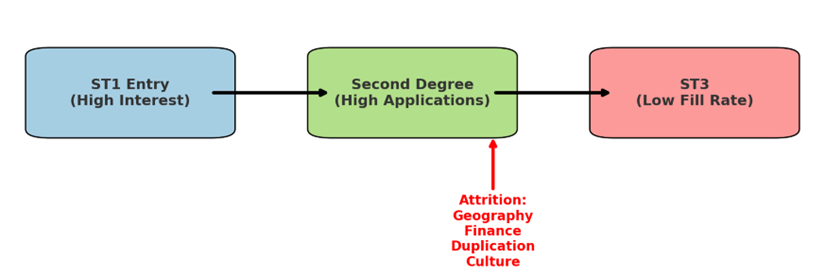
Together, these frictions explain why enthusiasm evaporates before higher training. This leakage is illustrated in Figure 1. This pattern is documented in the BAOMS JTG report (1). This imbalance risks reinforcing perceptions that OMFS is primarily a dental specialty, deterring medical-first graduates.
3. Over-Investing at the Start, Under-Investing in the Transition
Much energy is spent widening the on-ramp: school outreach, undergraduate tasters, and social media campaigns. These raise awareness but fail to fix attrition. Evidence suggests there are already enough entrants to sustain OMFS if progression could be secured (3). The crisis is therefore not one of attraction but of retention through transition. Unless the bridge is reinforced, OMFS will continue to leak appointable candidates.
4. International Comparisons: Lessons for the UK
In the United States, many OMFS residencies are integrated six-year programmes that combine dental and medical training, and several European systems recognise prior learning to shorten overall duration. These models show that attrition is shaped by training design rather than inevitability, whereas the UK pathway remains unusually protracted and disjointed. Adopting elements of international models could help address the UK's middle-mile leak, while still preserving the breadth and depth of dual qualification. International lessons demonstrate that proactive policy design, when coupled with financial and structural support, can stabilise even complex training pathways. The UK should treat adaptation as obligatory to secure OMFS and maintain parity.
5. Proposed Remedy: A Bonded, Locally Responsive, Run-Through Pathway (BLR-OMFS)
(i) Co-commissioned, bonded second-degree places linked to local ST posts
Building on the Walport model, second-degree seats should be tied directly to future local higher training posts, funded and bonded by region. Candidates would be locally recruited, nationally benchmarked, and contractually committed to serve in the commissioning region for a set period. This aligns incentives: trainees gain security, regions gain workforce continuity (6).
(ii) Modularise and de-duplicate competencies
Curricula across OMFS, oral surgery, and core surgical training should be mapped to allow credit transfer of prior learning. By recognising competencies already achieved, training can be shortened without reducing quality. The JTG has explicitly called for competency-based progression to replace time-based repetition (1).
(iii) Protect training time through workforce redesign
Service demands increasingly erode theatre time. Rooney et al. highlight both opportunities and risks in deploying Medical Associate Professionals (MAPs) within OMFS. With careful governance, MAPs can assume routine service tasks, freeing trainees for theatre exposure and case leadership. Training-first rota design must become the default (8).
(iv) Equalise early exposure for medical-first graduates
The imbalance in early posts must be corrected by expanding FY1/FY2 placements in OMFS. Balanced exposure ensures that both medical and dental graduates encounter the breadth of the specialty, improving recruitment diversity (7).
(v) Fund the middle mile, not just the start line
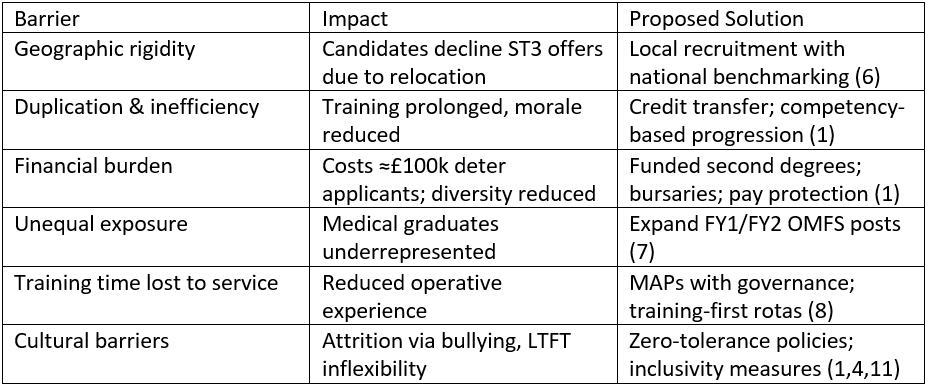
Government and NHS employers should offer targeted bursaries and reinstated pay protection for second-degree students. Compared to the recurring costs of locum cover, such investment is fiscally prudent and symbolically important, signalling institutional commitment to OMFS trainees (1). Together, these reforms would reshape the OMFS pathway into a more coherent, financially sustainable, and geographically responsive training model. A consolidated summary of barriers and solutions is provided (see Table 1).
6. Measurement: Making the Middle Mile Visible
The adage 'what gets measured gets managed' applies. Recruitment dashboards currently highlight ST1 ratios but ignore the middle mile. Instead, the specialty should track:
- Appointable-but-Unallocated (ABU) rates at ST3.
- Offer-decline rates, with coded reasons.
- Transition rates from second degree to ST within 24–36 months.
- Training-time protection indices (theatre sessions per trainee per month).
Publishing such metrics would hold training bodies accountable for progression, not merely attraction.
7. Culture: Retention Is as Critical as Recruitment
The GMC’s 2023 survey highlights persistent concerns around well-being, bullying, and work–life balance across surgical training (4). Persistent exposure to such environments contributes to burnout and loss of morale, reducing not only retention but also the diversity of those who progress into senior training. Addressing these systemic issues is therefore a prerequisite for a resilient OMFS workforce. The RCS Women in Surgery report (11) underlines how inflexibility disproportionately impacts women, compounding attrition. Providing genuine less-than-full-time (LTFT) flexibility is central to retention.
8. Attraction Still Matters—but Should Be Curated, Not Commodified
Attraction strategies remain useful, but they must focus on sustaining candidates through the middle mile. The BAOMS Mentoring and Support Programme (MSP), alongside the long-running 'Register Your Interest in OMFS' platform, already provide proven infrastructure (9). These should be integrated into run-through pathways, pairing each bonded place with dedicated mentorship.
Branding also matters. Surveys show candidates are drawn not to dentoalveolar work but to variety, reconstructive complexity, and technological innovation (10). By presenting OMFS as a purpose-driven, technologically advanced specialty—leveraging virtual surgical planning, 3D printing, robotics, and regenerative medicine—it can sharpen its appeal against rival surgical disciplines (12).
Figure 1. OMFS Workforce Pipeline and 'Middle Mile' Leakage (Author-generated)
Table 1. Barriers to OMFS Recruitment and Proposed Solutions
Conclusion
OMFS recruitment is not failing because students and trainees lack interest. It is failing because our system has built an inviting on-ramp but a narrow, leaky bridge. The evidence is clear: candidates are willing, able, and appointable—but too many are lost in the middle mile.
The solution is equally clear. We must restructure recruitment and training into a bonded, locally responsive, run-through pathway, tied to funded second-degree places and future local posts. We must remove duplicated competencies, protect training time, and equalise early exposure. We must publish metrics that make the middle mile visible and hold systems accountable. Above all, we must ensure culture supports—not undermines—long training journeys.
If nothing changes, OMFS risks worsening vacancy rates, increasing reliance on locums, and erosion of diversity, with direct consequences for patient care. Yet this crisis is also an opportunity. By fixing the middle mile, OMFS can rebrand itself as a future-facing specialty, leading in virtual surgical planning, robotics, and regenerative medicine (12). More than securing its own workforce, OMFS could serve as a blueprint for surgical recruitment reform across specialties. If action is taken now, the ≈50% fill rates at ST3 (1) will be a relic of the past, and OMFS can not only secure its workforce but also model how surgical specialties adapt to 21st-century challenges in the decades ahead. With decisive reform, the UK could not only stabilise its own OMFS pipeline but also provide a global model for sustaining dual-qualified specialties in the 21st century.
References
1. BAOMS Junior Trainees Group. State of Play Report. Dec 2024. Available at: https://www.baoms.org.uk (Accessed 3 Sept 2025).
2. NHS England. Recruitment Fill Rates. Oct 2024.
3. Magennis C, Davies A, King R, et al. Oral and maxillofacial surgery (OMFS) ‘controlled’ second-degree places in the UK—there are sufficient numbers (with high application ratios) to meet current and future OMFS recruitment needs. Br J Oral Maxillofac Surg. 2025;63(2):104-111.
4. General Medical Council. National Training Survey 2023. London: GMC; 2023.
5. Al-Najjar Y, Rowe A, Naredla P, Magennis P, Smith AT. Three changes to reduce the loss of dual-degree trainees from OMFS national specialty selection in the UK. Br J Oral Maxillofac Surg. 2022;60(1):36-41.
6. Sharma D, Douglas J, Begley A, Hutchison I, Magennis P. UK OMFS surgeons support changes to recruitment, including Walport-style local selection. Br J Oral Maxillofac Surg. 2024;62(5):483-488.
7. Emms G, Nguyen V, Elliott E, Mannion C. The composition of England’s single-qualification OMFS posts: descriptive analysis. Br J Oral Maxillofac Surg. 2025;63(2):139-143.
8. Rooney J, et al. Medical associate professionals in OMFS: opportunities and caveats. Br J Oral Maxillofac Surg. 2024;62(8):770-776.
9. Magennis P, Begley A, McLean A, et al. The UK Mentoring and Support Programme (MSP) for aspiring OMFS (2008–2020). Br J Oral Maxillofac Surg. 2021;59(8):935-940.
10. Kent S, Herbert C, Magennis P, Cleland J. What attracts people to a career in OMFS? Br J Oral Maxillofac Surg. 2017;55(1):41-45.
11. Royal College of Surgeons of England. Women in Surgery: Making it Happen. London: RCS Eng; 2021.
12. Mehra P, et al. Advances in technology and innovation in oral and maxillofacial surgery. Br J Oral Maxillofac Surg. 2021;59(9):1024-1030.
